

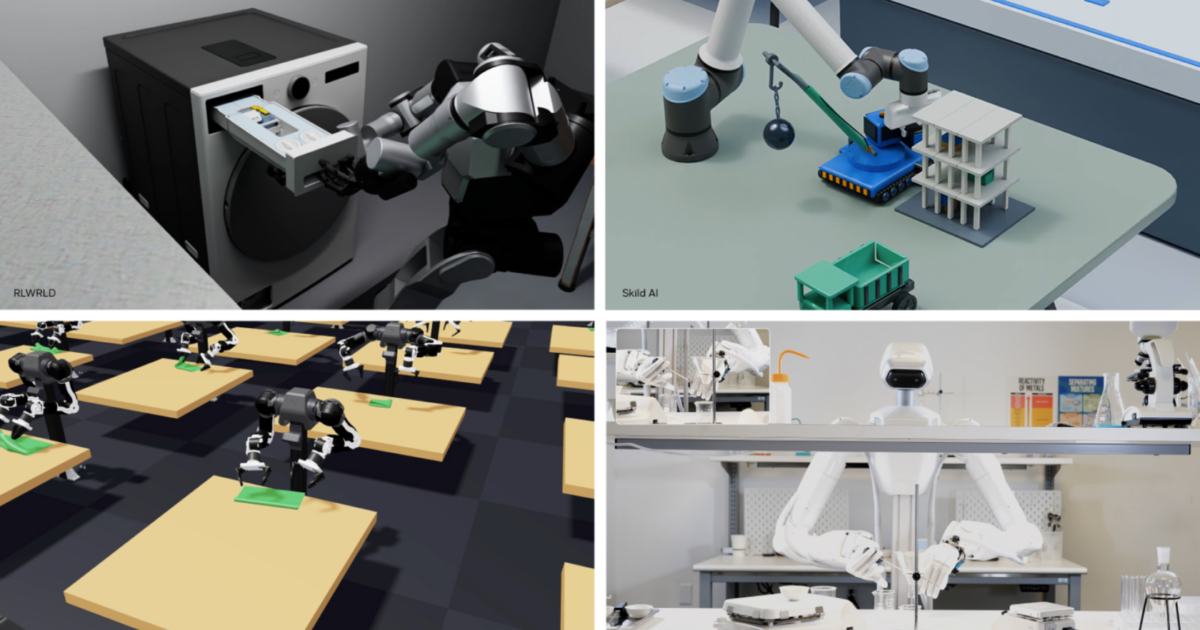
At the Conference on Robot Learning in Austin, Texas, NVIDIA introduced open robotics technologies including the GR00T 2 world action model and Isaac Lab 3.0. These tools aim to help researchers train robots on complex manipulation tasks using simulation.
What it means for robot training
NVIDIA stated that its new GR00T 2 open frontier world action model achieved a 71% average success rate across 50 tasks with just one demonstration per task, which increased to 95% with five demonstrations. According to NVIDIA, the model completed 40 of 50 evaluated tasks at least once without task-specific demonstrations.
NVIDIA reported that GR00T 2 currently ranks among the top three models across all vision language action and world action model categories for benchmarks like RoboCasa365, RoboLab, RoboDojo, and MolmoSpaces. Companies such as Foxconn, Siemens, and Nexuni are testing or evaluating the model for factory automation and laundry handling.
Simulation and Physics Engine Updates
NVIDIA announced the release of Isaac Lab 3.0, an open source robot-learning framework that lets researchers use agents to quickly set up training environments. According to NVIDIA, the updated framework features tighter integration with the Newton physics engine to model deformable objects like cables and cloth.
NVIDIA stated that Isaac Lab 3.0 with Newton achieved up to 2.5x the training throughput of Isaac Lab 2.3 with PhysX in a vision-based dexterous manipulation benchmark. Additionally, Skild AI introduced STEEL, a new rigid-body physics solver built on Newton to accelerate robot training with Isaac Lab.
Key facts and where they come from
- GR00T 2 achieved a 71% average success rate across 50 tasks with one demonstration, increasing to 95% with five.
Achieved 71% average success across 50 tasks with just one demonstration per task, increasing to 95% with five.
- Isaac Lab 3.0 with Newton achieved up to 2.5x the training throughput compared to Isaac Lab 2.3 with PhysX.
Isaac Lab 3.0 with Newton achieved up to 2.5x the training throughput of Isaac Lab 2.3 with PhysX.
- GR00T 2 completed 40 of 50 evaluated tasks at least once without task-specific demonstrations.
Completed 40 of 50 evaluated tasks at least once without task-specific demonstrations.
The open question: How will different physics solvers like Newton and PhysX impact the real-world transferability of complex robot manipulation tasks?