Latest tech news
Every story, newest first.
ESA astronaut Sophie Adenot logs 19 hours in three spacewalks
ESA says Adenot spent 19 hours and 42 minutes outside the International Space Station across three extravehicular activities in less than 15 days.
 ESA
Vulnerability Watch, October 2, 2026: 11 critical CVEs and 34 new vendor and CERT advisories
Every critical-severity CVE NIST published in the past day, plus the latest advisories from national CERTs and vendors.
 NIST
Galileo logs first authenticated position fix at Jammertest
ESA says receivers in Norway fixed their position using Galileo's upcoming encrypted Signal Authentication Service, which is meant to detect and reject spoofing attacks.
ESA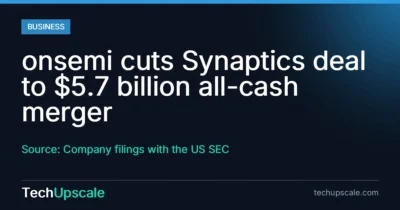
onsemi cuts Synaptics deal to $5.7 billion all-cash merger
The chipmakers said they amended their June 25, 2026 agreement after an unsolicited competing proposal, lowering the price to $123 per share in cash.
Company filings with the US SEC
Google says Project Suncatcher prototype satellite reaches orbit
Google says the Planet-built prototype launched on SpaceX's Transporter-18 rideshare will test how its TPUs cope with radiation and thermal extremes in space.
 Google
MIT Transit Lab wins $2.1M from Google.org for AI transit hub
The three-year Public Transit Intelligence Hub project aims to merge fragmented control-center data into one AI-orchestrated platform for transit staff and riders.
 MIT

Google AI model tops CDC FluSight flu hospitalization ranking
Google says its forecasting model, built with an AI tool called Empirical Research Assistance, best matched observed U.S. flu hospital admissions in the 2025-26 season.
Google
Microsoft tracks Zimbra flaw CVE-2026-73570 exploited in the wild
Microsoft Threat Intelligence says attackers used a crafted email to run commands on internet-facing Zimbra servers, deploying web shells and stealing authentication keys.
 Microsoft

Cisco Talos details tactics to frustrate attackers in networks
Eight Talos researchers recommend deception, behavior-based detection, RMM allowlisting and tighter AI agent boundaries to make adversary operations slower and noisier.
 Cisco Talos
Google DeepMind extends SynthID watermarks to AI-made proteins
The company says its SynthID Bio watermarks survive into physical proteins and could help DNA synthesis providers verify that orders came from trusted AI models.

 Google DeepMind