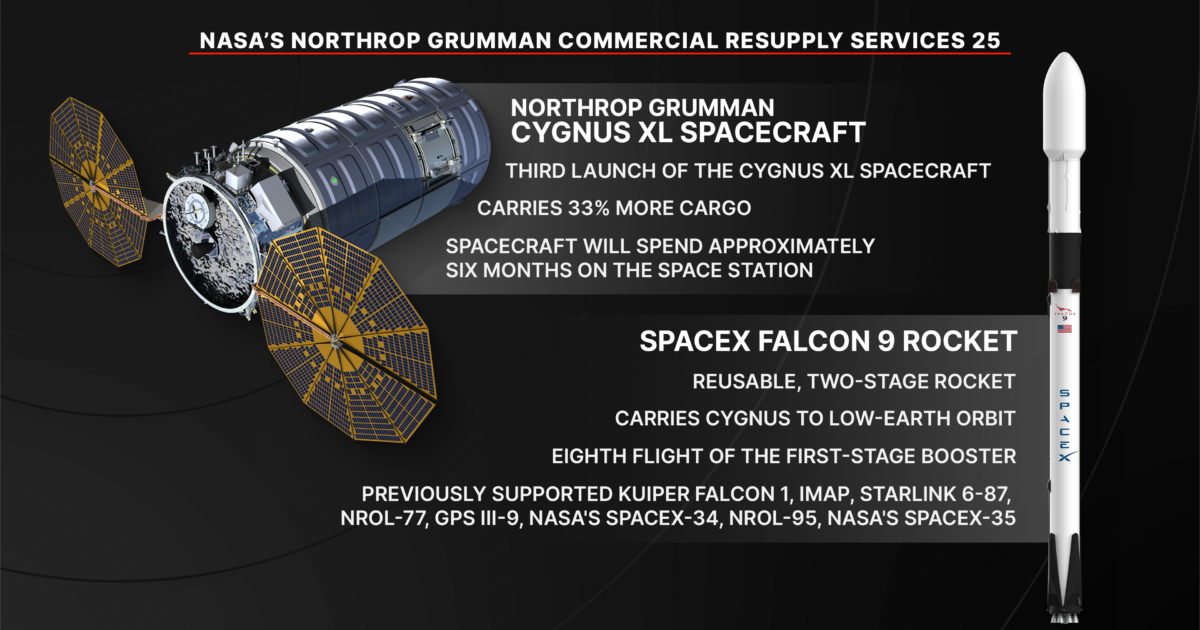
NASA is gearing up to send roughly 11,000 pounds of science experiments, supplies, and hardware to the International Space Station on the Northrop Grumman CRS-25 mission. Scheduled to launch aboard a SpaceX Falcon 9 rocket, the flight marks the third journey for the larger Cygnus XL spacecraft.
What is on board
The Cygnus XL will carry a mix of crew supplies and high-tech experiments designed for long-duration spaceflight and medical research on Earth. You will find investigations like Cardinal Muscle 2.0, which explores treatments for muscle loss using human muscle cell cultures in microgravity.
Another project, DNA NANO B, aims to manufacture tiny, DNA-inspired particles to deliver medicine into dense tissues like cartilage and solid tumors. The flight also carries the OHALO III plant growth facility to test food crop production for future deep space missions.
Technology demonstrations
The mission also features the JOining demonstrations IN-Space (JOINS) project, testing autonomous robotic welding inside the Bishop Airlock. JOINS will try out laser beam welding and friction stir welding on aluminum and stainless-steel materials.
Additionally, the Active Radiation Environment Sensor (ARES) will test a small radiation monitoring device inside crew living areas to support future Artemis program and lunar missions.
Key facts and where they come from
- The CRS-25 mission will deliver about 11,000 pounds of cargo to the space station.
NASA’s Northrop Grumman Commercial Resupply Services 25 mission, or Northrop Grumman CRS-25, will deliver about 11,000 pounds of science and supplies to the International Space Station.
- The Cygnus XL spacecraft will launch on a SpaceX Falcon 9 rocket from Florida.
The Cygnus XL will launch aboard a SpaceX Falcon 9 rocket from the Cape Canaveral Space Force Station in Florida.
- Ohalo III is designed to test crop production for long-duration missions.
Ohalo III is a new plant growth facility designed to help food crop production on future long-duration missions.