NASA
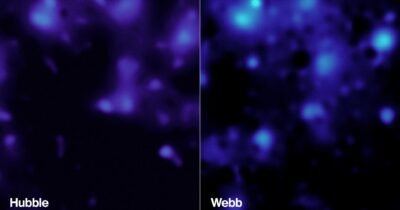
Webb Telescope Captures Stellar Nursery Commotion in NGC 7129
The James Webb Space Telescope imaged a distant stellar nursery, revealing how stars shape surrounding gas and dust.
 ESA
NASA’s SpaceX Crew-12 Wraps Station Science Mission, Heads Home
NASA says the four-member Crew-12 team returns in early October after work spanning quantum physics, metal 3D printing and in-orbit IV fluid production.
 NASA
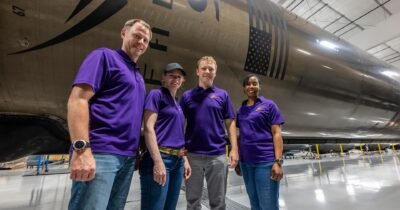
Rosalind Franklin Mars rover set for Falcon Heavy launch in 2028
The UK Space Agency says NASA has approved a support project for Europe's first Mars rover and picked SpaceX's Falcon Heavy, with landing expected in 2030.
 UK Space Agency
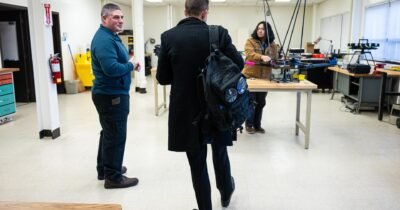
NASA tests pressure sensitive paint on model wing in Langley tunnel
NASA says the first-of-its-kind test shows how unsteady Pressure Sensitive Paint can measure airflow on a large, freely moving wing model, feeding better flight simulations.
NASA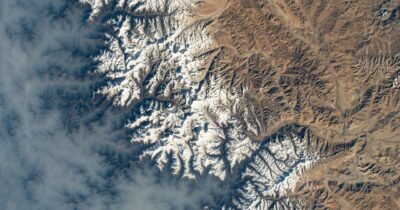
NASA satellites map record Gandak River flooding in Nepal, India
NASA Earth Observatory published MODIS false-color images showing the Gandak River swelling after late-monsoon rains pushed gauges to record highs in Nepal and India.
NASA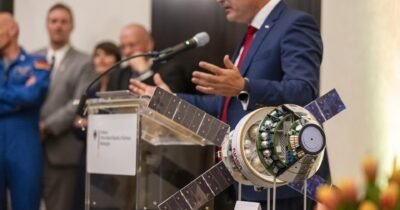
NASA, CSA, German Aerospace Center plan lunar crop demonstrator
The three agencies signed a joint statement of intent to prepare an Earth-based demonstrator for growing crops under Moon-like conditions, NASA said.
NASA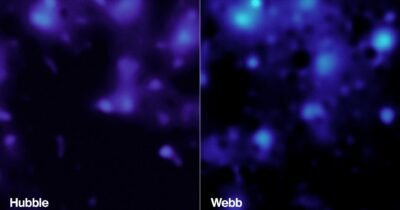
NASA’s Webb maps 21 extreme debris disks from planet smashups
Astronomers using the James Webb Space Telescope assembled the largest sample yet of extreme debris disks, linking their dust chemistry to collisions between Mars- and Moon-sized bodies.
NASA
NASA’s SpaceX Crew-13 Launches on Fastest Flight to Station
NASA said the Dragon spacecraft carrying four astronauts will dock about 7 hours and 50 minutes after liftoff, the quickest launch-to-docking by a U.S. spacecraft at the ISS.
NASA
NASA launches Overlap Zoo to map cosmic dust in galaxy pairs
NASA says volunteers can help verify and outline overlapping galaxies to build the first large-scale catalog suitable for interstellar dust studies.
NASA
NASA opens 2027 Human Lander Challenge for lunar comms ideas
NASA is asking U.S. college teams for systems-level lunar communications concepts that could be implemented within three to five years, with finalists sharing cash awards.
NASA