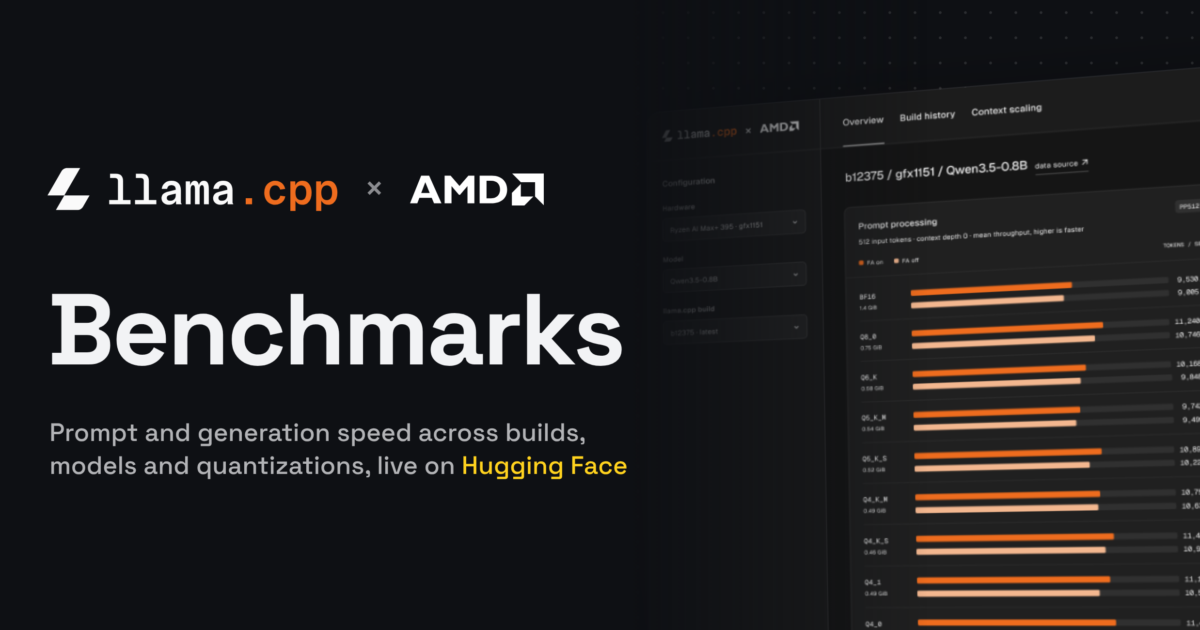
Hugging Face released a new benchmark dashboard on November 26, 2026, to track prompt processing and text generation performance for llama.cpp on AMD Ryzen and Radeon hardware.
Dashboard Features and Hardware
The llama.cpp AMD Benchmark dashboard lets developers track performance across builds, models, and quantizations. The initial hardware choices are Radeon 8060S (gfx1151) and Radeon AI Pro R9700S (gfx1201).
The dashboard includes an Overview tab for comparing quantizations, a Build history tab for tracking performance across recorded builds, and a Context scaling tab to observe how token-generation throughput changes as context grows.
Workloads and Models
Benchmarks measure two core workloads in tokens per second: PP512 for processing 512 input tokens and TG128 for generating 128 output tokens. Both tests begin at context depth zero.
The model set covers dense and mixture-of-experts architectures, including Inkling 2 Mini, Qwen, Gemma, gpt-oss, and LFM models. Available GGUF formats include Q4_K_M, Q8_0, BF16, and F16.
Key facts and where they come from
- Hugging Face launched the llama.cpp AMD Benchmark dashboard.
The llama.cpp × AMD Benchmark dashboard is available on Hugging Face.
- Current supported hardware choices are Radeon 8060S and Radeon AI Pro R9700S.
The current hardware choices are Radeon 8060S (gfx1151) and Radeon AI Pro R9700S (gfx1201).
- Benchmarks measure workloads in tokens per second using PP512 and TG128 tests.
The dashboard shows two separate tests, both measured in tokens per second: